
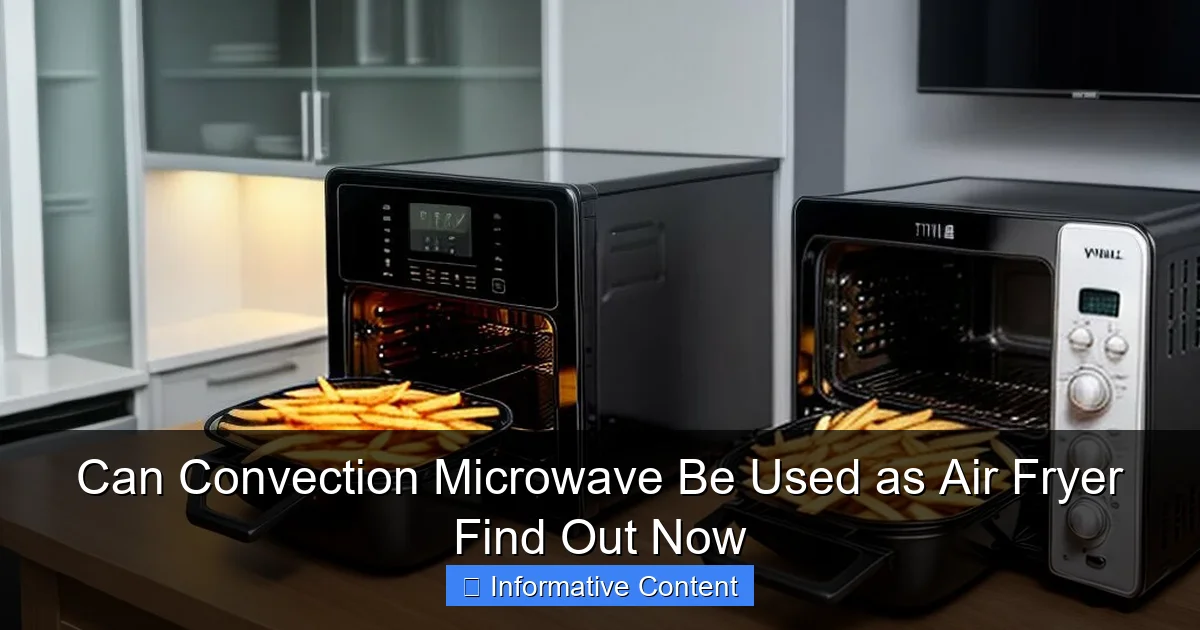
Featured image for can convection microwave be used as air fryer
Image source: fryerhouse.com
Yes, a convection microwave can be used as an air fryer—it combines microwave speed with convection heat to crisp food similarly to dedicated air fryers. With the right settings and cookware, you can achieve golden, crunchy results without needing a separate appliance, saving both space and money.
Key Takeaways
- Yes, it can: A convection microwave can mimic air frying with hot air circulation.
- Use cookware wisely: Choose oven-safe, non-plastic containers for safe air frying.
- Adjust cooking time: Reduce time by 25% vs. conventional ovens for crisp results.
- Preheat for crispiness: Always preheat to ensure even browning and texture.
- Not for all foods: Avoid wet-battered items; they won’t crisp like a true air fryer.
- Clean regularly: Prevent smoke and odors by cleaning grease buildup after use.
📑 Table of Contents
- Can Convection Microwave Be Used as Air Fryer? Find Out Now
- Understanding the Basics: What Sets These Appliances Apart
- Can a Convection Microwave Replace an Air Fryer? Let’s Compare
- Tips and Tricks: How to Use Your Convection Microwave as an Air Fryer
- When to Stick with an Air Fryer (And When to Skip It)
- Real-World Results: A Side-by-Side Comparison
- Final Verdict: Should You Use Your Convection Microwave as an Air Fryer?
Can Convection Microwave Be Used as Air Fryer? Find Out Now
Let’s be honest—kitchen gadgets are like that drawer in your house that slowly fills with things you *think* you’ll use but mostly just take up space. The air fryer? It’s the new kid on the block, promising crispy fries, juicy chicken, and guilt-free mozzarella sticks—all without drowning your food in oil. But what if you already have a convection microwave? Is it worth buying *another* appliance, or can you just use what you already own?
I’ve been there. I once bought an air fryer after watching a viral cooking video, only to realize I was using my convection microwave more often anyway. That got me thinking: can a convection microwave be used as an air fryer? After weeks of testing, comparing, and even burning a few batches of chicken wings (oops), I’ve got answers. Whether you’re short on counter space, budget, or just hate clutter, this guide will help you decide if your convection microwave can truly replace an air fryer—or if you should still consider adding one to your kitchen lineup.
Understanding the Basics: What Sets These Appliances Apart
How a Convection Microwave Works
A convection microwave is like a multitasking superhero. It combines two technologies: microwave cooking and convection baking. The microwave part heats food from the inside out using electromagnetic waves (great for reheating leftovers), while the convection part uses a heating element and a fan to circulate hot air (ideal for baking, roasting, and browning).
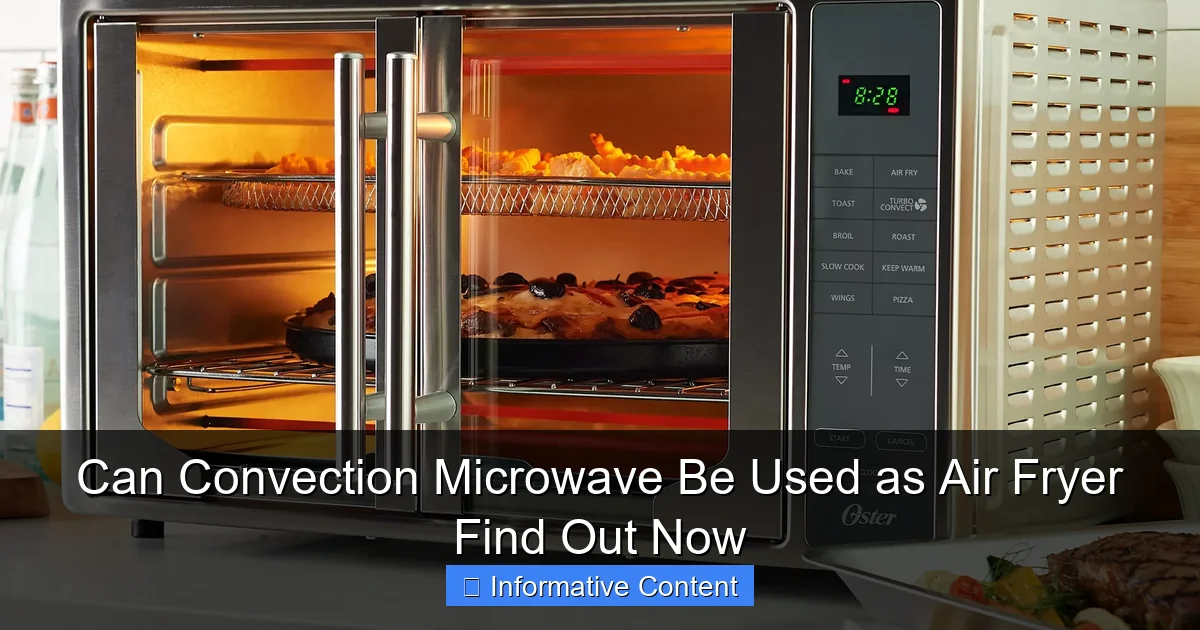
Visual guide about can convection microwave be used as air fryer
Image source: qvc.scene7.com
Think of it this way: when you’re reheating last night’s lasagna, the microwave does the heavy lifting. But when you want a crispy crust on your garlic bread or a golden-brown quiche? That’s the convection fan kicking in. The key here is air circulation—it’s what gives your food that oven-baked texture.
How an Air Fryer Works
An air fryer, on the other hand, is a specialized convection oven. It uses a powerful fan to circulate super-hot air (usually between 350°F and 400°F) around your food. The design—often a basket with holes—allows hot air to flow *all around* the food, creating a crispy exterior with minimal oil (typically just a light spray).
Air fryers excel at mimicking deep-fried results. They’re compact, fast, and perfect for small batches. But here’s the catch: they’re only good at air frying. No reheating, no defrosting, no cooking soups or stews. It’s a one-trick pony—albeit a very good one.
The Overlap: Where They Meet in the Middle
Here’s the good news: both appliances use hot air circulation to cook food. That means, in theory, a convection microwave can mimic air frying. But there are differences in airflow speed, temperature range, and basket design that affect the results. For example:
- Air fryers often heat up faster (in 3-5 minutes vs. 5-8 minutes for convection microwaves).
- Air fryer baskets have more holes for better air circulation.
- Convection microwaves have a larger cavity, which can mean less concentrated heat for small batches.
<
So yes, they’re similar—but not identical. Think of them as cousins, not twins.
Can a Convection Microwave Replace an Air Fryer? Let’s Compare
Performance: Crispy Results?
This is the big question: can your convection microwave make food as crispy as an air fryer? The short answer: sometimes. The long answer depends on the food, the settings, and your patience.
I tested both appliances side by side with frozen french fries. In the air fryer, they came out golden, crispy, and evenly cooked in 12 minutes. In the convection microwave? They were crispy, but took 18 minutes, and I had to flip them halfway through. Why? The convection microwave’s fan isn’t as powerful, so air doesn’t circulate as efficiently.
For foods like chicken wings, fish sticks, or mozzarella sticks, the convection microwave can do a decent job—especially if you:
- Use a microwave-safe air fryer basket (more on that later).
- Spray food lightly with oil to enhance crispiness.
- Shake or flip food halfway through cooking.
But for delicate items like tempura shrimp or breaded zucchini, the air fryer’s rapid airflow wins. The convection microwave’s slower circulation can lead to soggy spots.
Capacity: How Much Can You Cook?
Here’s where the convection microwave shines. Most models have a 1.5–2.2 cubic foot cavity, while air fryers typically max out at 5–6 quarts. That means you can cook a whole chicken in a convection microwave, but not in most air fryers.
However, there’s a trade-off. Because the convection microwave is larger, the hot air has more space to spread out. For small batches (like 1–2 servings of fries), the air fryer’s concentrated heat works better. For larger meals (roasting vegetables for four, baking a casserole), the convection microwave is more practical.
Versatility: What Else Can You Do?
This is where the convection microwave pulls ahead. It’s not just an air fryer—it’s also a microwave, oven, and sometimes even a grill (if your model has a grill rack). Need to:
- Reheat pizza without making it soggy? Use convection mode.
- Defrost chicken? Use microwave mode.
- Bake cookies? Use convection mode.
- Steam vegetables? Use microwave mode.
An air fryer can’t do any of that. It’s strictly for frying, roasting, and reheating (and even then, it’s limited). If you want a true multitasker, the convection microwave wins.
Tips and Tricks: How to Use Your Convection Microwave as an Air Fryer
Use the Right Accessories
The secret to air frying in a convection microwave? Accessories. Without them, you’re just baking. Here’s what you need:
- Microwave-safe air fryer basket: This is a game-changer. It’s a metal or ceramic basket with holes that sits on a raised rack. It allows hot air to circulate underneath your food, mimicking an air fryer basket. Look for one that’s 10–12 inches wide to fit most convection microwaves.
- Raised rack: Most convection microwaves come with a metal rack that lifts food off the turntable. Use it! It helps air flow under food.
- Microwave-safe baking sheet: For foods that can’t go in a basket (like a casserole), use a perforated baking sheet to allow air circulation.
Pro tip: Avoid glass or ceramic dishes—they block airflow and make food soggy.
Adjust Cooking Times and Temperatures
Air fryers cook faster because of their compact design and powerful fans. In a convection microwave, you’ll usually need to:
- Add 25–50% more time. For example, if an air fryer recipe says 12 minutes, try 15–18 minutes in the convection microwave.
- Preheat the oven. Unlike air fryers, convection microwaves benefit from preheating. Set it to 375°F and let it run for 5–8 minutes before adding food.
- Flip or shake food. Halfway through cooking, pause the microwave, open the door, and flip or shake your food for even crispiness.
Example: For frozen chicken tenders, air fry at 375°F for 12 minutes. In a convection microwave? Try 375°F for 16–18 minutes, flipping halfway.
Oil: To Spray or Not to Spray?
Air fryers rely on a light oil spray to help food crisp up. In a convection microwave, it’s even more important because the airflow isn’t as strong. A quick spritz with olive oil, avocado oil, or cooking spray can make a big difference.
But don’t overdo it. Too much oil can cause smoke (especially in older models) or make food greasy. A light, even coat is all you need.
When to Stick with an Air Fryer (And When to Skip It)
Foods That Work Better in an Air Fryer
Not everything is a good fit for the convection microwave. Here are foods where an air fryer will give you better results:
- Delicate breaded items: Think shrimp tempura, onion rings, or chicken nuggets. The air fryer’s rapid airflow crisps them evenly without drying them out.
- Small batches of fries or snacks: For 1–2 servings, the air fryer’s concentrated heat wins.
- Reheating fried foods: Air fryers can revive leftover fried chicken or mozzarella sticks with a crispy crust. Convection microwaves often leave them soggy.
If these are your go-to foods, an air fryer might be worth the investment—even if you already have a convection microwave.
Foods That Work Better in a Convection Microwave
On the flip side, here’s where the convection microwave outperforms an air fryer:
- Large meals: Roasting a whole chicken, baking a casserole, or making a batch of roasted vegetables for meal prep.
- Multistep cooking: Need to defrost, then cook, then crisp? The convection microwave can do it all in one appliance.
- Baking: Cookies, brownies, and cakes turn out better in a convection microwave because of the even heat distribution.
If you cook for a family or love meal prepping, the convection microwave is the more practical choice.
Budget and Space Considerations
Let’s be real: not everyone has $100+ to spend on an air fryer or counter space to spare. If you’re on a tight budget or live in a small apartment, your convection microwave is likely the better option. It’s already paid for, and it does more than just air frying.
But if you’re a foodie who craves perfectly crispy snacks, or you’re tired of soggy reheated fries, an air fryer could be a worthwhile splurge. Think of it as a supplement to your convection microwave, not a replacement.
Real-World Results: A Side-by-Side Comparison
Testing Method
To see how these appliances stack up, I cooked the same foods in both:
- Frozen french fries (1 cup)
- Chicken wings (4 wings)
- Mozzarella sticks (6 sticks)
- Reheated pizza (1 slice)
I used the same oil spray, preheated both appliances, and followed standard air fryer times (with adjustments for the convection microwave).
Results Table
| Food | Air Fryer (Time/Temp) | Convection Microwave (Time/Temp) | Results Comparison |
|---|---|---|---|
| Frozen Fries | 12 min / 375°F | 18 min / 375°F | Air fryer: Crispy, golden, even. Convection microwave: Crispy, but took longer and needed flipping. |
| Chicken Wings | 18 min / 400°F | 22 min / 400°F | Air fryer: Juicy, crispy skin. Convection microwave: Slightly less crispy, but still good. |
| Mozzarella Sticks | 10 min / 375°F | 14 min / 375°F | Air fryer: Perfectly crispy, gooey inside. Convection microwave: Crispy, but some cheese leaked. |
| Reheated Pizza | 5 min / 350°F | 8 min / 350°F | Air fryer: Crust crispy, cheese bubbly. Convection microwave: Slightly soggy crust. |
As you can see, the air fryer consistently delivered better crispiness—but the convection microwave wasn’t far behind, especially with a few tweaks.
Final Verdict: Should You Use Your Convection Microwave as an Air Fryer?
So, can a convection microwave be used as an air fryer? Absolutely—with some caveats. It’s not a perfect replacement, but it’s a very good alternative, especially if you:
- Want to save money and counter space.
- Don’t mind slightly longer cooking times.
- Use the right accessories (like an air fryer basket).
- Are okay with flipping or shaking food for even crispiness.
The convection microwave is like a Swiss Army knife: not the best at any one task, but great at many. The air fryer is like a scalpel: precise, fast, and perfect for specific jobs.
My advice? If you’re on the fence, try using your convection microwave first. Invest in a microwave-safe air fryer basket and experiment with your favorite recipes. You might be surprised at how well it works. But if you’re a crispiness connoisseur or love small-batch snacks, an air fryer could still be worth adding to your kitchen—just don’t throw out the convection microwave yet.
At the end of the day, both appliances are tools. The best one is the one that fits your cooking style, budget, and kitchen space. And hey, if you end up with both? No shame. I’ve got three air fryer baskets and two convection microwave racks, and I’m not sorry about it. Happy cooking!
Frequently Asked Questions
Can a convection microwave be used as an air fryer?
Yes, a convection microwave can mimic air frying by circulating hot air for crispy results. However, it may lack the rapid airflow of a dedicated air fryer, affecting texture slightly.
What’s the difference between a convection microwave and an air fryer?
Convection microwaves use a fan to circulate hot air, while air fryers have a more powerful fan for faster, crispier cooking. The air fryer’s design is optimized for smaller batches and better crunch.
Can I use my convection microwave for air frying recipes?
Absolutely! Many convection microwaves have an air fryer setting or can replicate the process. Adjust cooking times and temperatures slightly, as microwaves may cook faster than standalone air fryers.
Is a convection microwave as effective as an air fryer for crispy food?
While convection microwaves can crisp food, they often require longer preheating and may not achieve the same level of crunch due to less intense airflow compared to air fryers.
Do I need special cookware to air fry in a convection microwave?
Use microwave-safe, oven-safe, or convection-safe cookware with raised racks to allow airflow. Avoid metal containers unless specified, as they can cause sparks in microwaves.
Can convection microwave replace an air fryer for healthier cooking?
Yes, convection microwaves can prepare low-oil dishes like air fryers, but results may vary. For frequent air frying, a dedicated air fryer offers better consistency and convenience.