

Featured image for can convection oven work as air fryer
Image source: m.media-amazon.com
Yes, a convection oven can work as an air fryer by circulating hot air to achieve crispy, evenly cooked results with less oil. While not identical, it mimics air frying effectively—ideal for roasting, baking, and “frying” with minor adjustments to time and temperature. Perfect for those seeking versatility without buying extra appliances.
Key Takeaways
- Yes, it can: Convection ovens mimic air fryers with rapid hot air circulation.
- Adjust temperature: Lower heat by 25°F to match air frying results.
- Use less oil: Achieve crispiness with minimal oil, like true air frying.
- Batch size matters: Cook smaller portions for even, faster crisping.
- No preheat needed: Skip preheating to save time and energy.
- Versatility wins: Convection ovens offer broader cooking options beyond air frying.
📑 Table of Contents
- Can Convection Oven Work as Air Fryer? Find Out Here
- Understanding How Convection Ovens and Air Fryers Work
- Can You Air Fry in a Convection Oven? Yes—With Caveats
- Key Differences That Impact Cooking Results
- Tips to Get Air-Fryer Results in Your Convection Oven
- When You Should (and Shouldn’t) Use Your Convection Oven as an Air Fryer
- Final Verdict: Should You Rely on Your Convection Oven?
Can Convection Oven Work as Air Fryer? Find Out Here
Have you ever stood in your kitchen, staring at a convection oven, wondering if it could do the same crispy, golden magic as that air fryer you’ve been eyeing? You’re not alone. The question “can convection oven work as air fryer?” pops up all the time—especially when you’re trying to save counter space, avoid buying another gadget, or just want to get the most out of what you already own.
I remember the first time I tried making “air-fried” chicken wings in my convection oven. I was excited—same crispy skin, less oil, right? But the results were… underwhelming. They cooked, yes, but they weren’t *crispy*. They were more like “baked with a little extra air movement.” That’s when I started digging deeper. Turns out, convection ovens and air fryers are cousins, not twins. They share a lot of DNA—especially when it comes to how they circulate hot air—but they’re not interchangeable in every situation. And that’s what we’re going to unpack today. Whether you’re on a budget, short on space, or just curious about how your kitchen tools stack up, this guide will help you understand the real differences, similarities, and how to get the best results from what you’ve got.
Understanding How Convection Ovens and Air Fryers Work
The Science of Hot Air Circulation
Let’s start with the basics. Both convection ovens and air fryers use forced convection—that’s a fancy way of saying they blow hot air around food to cook it faster and more evenly. Traditional ovens heat from the top and bottom, creating hot spots and cold zones. But convection ovens have a fan (or two) that actively circulates the air. This reduces cooking time by up to 25% and gives a more consistent result. Air fryers do the same thing—but in a much smaller space.
Visual guide about can convection oven work as air fryer
Image source: realfoodwithsarah.com
Think of it like this: a convection oven is like a big room with a ceiling fan. An air fryer is like a tiny closet with a powerful fan. Because the air fryer is smaller, the hot air moves faster and hits the food from all angles more aggressively. That’s why air fryers can create that deep, golden crispiness with minimal oil.
Size, Speed, and Heat Transfer
Size matters—especially in cooking. Air fryers typically range from 2 to 6 quarts, while convection ovens can be 10 times that size (or more). The smaller volume of an air fryer means:
- Hot air reaches the food faster
- Moisture evaporates more quickly
- Food cooks more evenly on the surface
- Crisping happens in minutes, not tens of minutes
For example, a batch of frozen fries might take 12–15 minutes in an air fryer at 400°F (205°C), but 25–30 minutes in a convection oven at the same temperature. Why? Because in the air fryer, the air is whipping around the fries at high speed, dehydrating the surface and triggering the Maillard reaction (that’s the browning and crisping process). In the convection oven, the same temperature, but the air is less intense and more dispersed.
So while both appliances use convection, the intensity and efficiency of heat transfer are different. That’s the key difference when asking, “Can convection oven work as air fryer?”
Can You Air Fry in a Convection Oven? Yes—With Caveats
The Good News: You Can “Air Fry” in a Convection Oven
Yes, you absolutely can get air-fryer-like results in a convection oven. It just takes a little tweaking. The core principle—hot, fast-moving air—is the same. So if you don’t own an air fryer, don’t panic. Your convection oven can step in. But you’ll need to adjust your approach.
Here’s what works:
- Use the convection setting—this is non-negotiable. Regular bake mode won’t cut it.
- Preheat the oven—just like an air fryer, preheating ensures immediate high heat when food hits the oven.
- Use a wire rack or perforated tray—this allows air to circulate under the food, mimicking the basket of an air fryer.
- Reduce cooking time by 20–25%—convection ovens cook faster than regular ovens, so don’t rely on standard bake times.
- Use less oil (or none at all)—air frying is all about minimal oil. Spray or toss with 1 tsp of oil per batch for crispiness.
Real-World Example: Crispy Brussels Sprouts
Let’s say you want crispy roasted Brussels sprouts. In an air fryer, you’d do this:
- Preheat to 375°F (190°C)
- Toss sprouts with 1 tsp olive oil, salt, pepper
- Cook for 12–15 minutes, shaking halfway
In a convection oven, do this instead:
- Preheat oven to 375°F with convection on
- Line a baking sheet with parchment, place a wire rack on top
- Toss sprouts with 1 tsp oil, spread on rack (don’t overcrowd!)
- Cook for 18–22 minutes, flipping halfway
Result? Nearly identical crispy edges, slightly more browning on the bottom due to the rack. Not *quite* as fast or as uniformly crispy as an air fryer, but close enough for most home cooks.
When It Works—And When It Doesn’t
Convection ovens excel at air-frying:
- Large batches (e.g., 2 lbs of chicken wings)
- Foods that benefit from even browning (e.g., roasted vegetables, whole chickens)
- Items that need space to crisp (e.g., breaded cutlets)
But they fall short when:
- You need ultra-fast cooking (e.g., 5-minute frozen mozzarella sticks)
- You want maximum crispiness with zero oil (air fryers win here)
- You’re cooking small, delicate items that need constant air exposure (e.g., shrimp, small fish fillets)
Bottom line: your convection oven can *simulate* air frying, but it’s not a perfect substitute. It’s more like a “pro version” of air frying—slower, but more versatile for larger meals.
Key Differences That Impact Cooking Results
Air Speed and Heat Density
Here’s where the real divergence happens. Air fryers use high-velocity fans (often 3,000–5,000 RPM) to blast hot air directly onto food. Convection ovens use slower fans (usually 1,000–2,000 RPM) in a much larger cavity. That means:
- Air fryers create a “turbulent” airflow—like a wind tunnel. This dehydrates the surface quickly, leading to crispiness.
- Convection ovens create a “laminar” or gentle airflow—more like a breeze. It’s great for even cooking, but not as effective for surface dehydration.
You can see this in action when cooking chicken wings. In an air fryer, the wings get crispy in 15–18 minutes. In a convection oven, even with a rack, they take 25–30 minutes and still have a slightly softer skin. The difference? The air fryer’s intense airflow strips moisture faster.
Basket vs. Baking Sheet: Surface Exposure Matters
Air fryers use perforated baskets that expose food on all sides. Convection ovens use flat baking sheets—even with a rack, the bottom still touches the surface. This reduces direct air exposure by about 30–40%.
To compensate, try these tricks:
- Use a perforated silicone mat (like a Crisp Plate) on your baking sheet—this lifts food and improves airflow.
- Flip food twice during cooking to ensure both sides crisp.
- Don’t overcrowd—leave at least 1 inch between items for air circulation.
Temperature and Preheating Precision
Air fryers heat up fast—usually in 3–5 minutes. Convection ovens take 10–15 minutes. This matters because air frying relies on immediate high heat to start crisping. If you put cold food into a cold oven, you lose that advantage.
Tip: Always preheat your convection oven. And if you’re doing multiple batches, keep the oven door closed between rounds to maintain heat. Opening the door drops the temperature by 25–50°F, which can ruin crispiness.
Tips to Get Air-Fryer Results in Your Convection Oven
Optimize Your Setup
You don’t need fancy tools, but a few upgrades can make a big difference:
- Wire rack: Elevates food, improves airflow. Use it on a baking sheet.
- Perforated tray or air fryer liner: Available for convection ovens, these mimic the air fryer basket.
- Light oil spray: Use avocado, canola, or grapeseed oil. Spray lightly—don’t drench.
- Aluminum foil with holes: DIY option—poke holes in foil and place on a rack.
Adjust Cooking Times and Temperatures
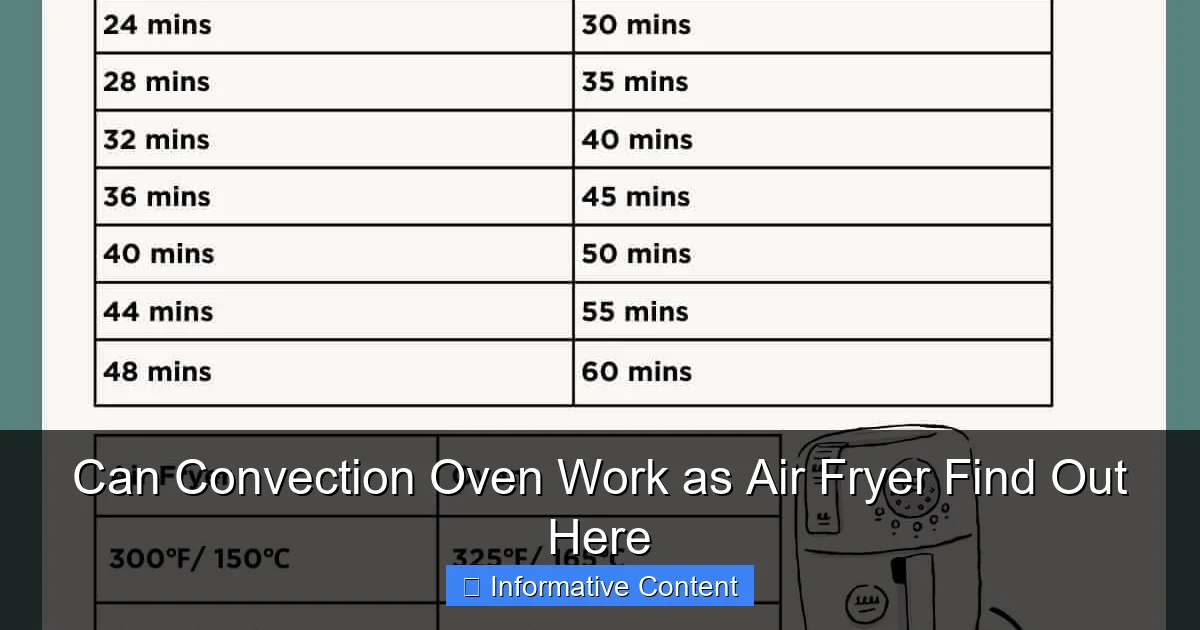
Convection ovens cook faster than regular ovens, but not as fast as air fryers. Here’s a quick conversion guide:
| Air Fryer Time/Temp | Convection Oven Time/Temp | Notes |
|---|---|---|
| 10 min @ 400°F | 15–18 min @ 375°F | Flip halfway |
| 15 min @ 375°F | 20–25 min @ 375°F | Use wire rack |
| 8 min @ 400°F (small items) | 12–15 min @ 400°F | Don’t overcrowd |
| 20 min @ 350°F (large items) | 25–30 min @ 350°F | Check internal temp |
Pro tip: Start checking food 3–5 minutes before the estimated time. Convection ovens vary by brand, and overcooking kills crispiness.
Best Foods to “Air Fry” in a Convection Oven
Some foods translate better than others:
- Vegetables: Brussels sprouts, broccoli, carrots, cauliflower—great for roasting with a crispy edge.
- Chicken wings, drumsticks, thighs: Use a rack, flip once, and you’ll get close to air fryer crispiness.
- Homemade fries: Soak in water, dry thoroughly, toss with oil, and bake on a rack.
- Frozen foods: Mozzarella sticks, chicken nuggets, tater tots—just extend time by 30–50%.
Avoid delicate items like fish fillets or shrimp—they dry out too fast in convection ovens without the precise control of an air fryer.
When You Should (and Shouldn’t) Use Your Convection Oven as an Air Fryer
When It’s a Great Idea
Your convection oven is perfect for air-frying when:
- You’re cooking for a crowd: Need 20 chicken wings? Your oven handles it. An air fryer might need 3 batches.
- You want even browning on large items: Roasting a whole chicken or turkey breast? Convection wins.
- You’re making multi-component meals: Roast veggies on one tray, chicken on another—all in the same oven.
- You’re on a budget: No need to buy another appliance. Use what you have.
For example, I once made a full “air fryer” dinner using only my convection oven: crispy tofu on a rack, roasted sweet potatoes on a second rack, and steamed broccoli in a pan below (using residual heat). It took 30 minutes total—and cleanup was easy.
When It Falls Short
There are times when your convection oven just can’t compete:
- Ultra-fast snacks: Want crispy mozzarella sticks in 8 minutes? Air fryer wins.
- Small, delicate foods: Shrimp, scallops, or thin fish fillets cook too fast and dry out in convection ovens.
- Maximum crispiness with zero oil: Air fryers dehydrate faster, creating a crunchier texture.
- Countertop convenience: Air fryers are portable, energy-efficient, and don’t heat up your kitchen.
I tried making air fryer “churros” in my convection oven. They came out edible—but not crispy. The air fryer version? Crispy on the outside, soft inside. The convection oven version? Uniformly dry, like a biscuit. Lesson learned: for texture-critical foods, an air fryer is worth the investment.
Final Verdict: Should You Rely on Your Convection Oven?
So, can convection oven work as air fryer? The short answer: **yes, with adjustments**. It’s not a perfect swap, but it’s close enough for 80% of what most people want to “air fry.”
If you already own a convection oven (and most modern ovens are convection-capable), you don’t need to rush out and buy an air fryer—especially if you cook for more than two people, or you’re not obsessed with ultra-crispy textures. Use the tips above: preheat, use a rack, flip food, reduce oil, and tweak cooking times. You’ll get great results.
But if you’re a texture junkie, love quick snacks, or cook small portions regularly, an air fryer is worth considering. It’s faster, more precise, and delivers that signature “air-fried” crunch that’s hard to replicate in a full-sized oven.
Think of it this way: your convection oven is a Swiss Army knife—versatile, reliable, and great for big jobs. The air fryer is a specialized tool—like a paring knife—designed for one thing, and it does it exceptionally well.
Ultimately, the best kitchen is one that works for you. If you’re happy with your convection oven results, keep using it. If you find yourself craving that extra crisp, faster cooking, or smaller footprint, then maybe it’s time to add an air fryer to the family.
And remember: cooking isn’t about the tool—it’s about the joy of making something delicious. Whether it’s a convection oven, air fryer, or even a cast-iron skillet, the goal is the same: crispy, golden, satisfying food. So experiment, have fun, and don’t stress if your fries aren’t perfectly air-fried. As long as they taste good and you enjoyed making them, you’ve won.
Frequently Asked Questions
Can a convection oven work as an air fryer?
Yes, a convection oven can mimic many air frying functions since both use a fan to circulate hot air for crispy, evenly cooked food. However, air fryers typically circulate heat more intensely and in a smaller space, which can lead to crispier results with less oil.
What’s the difference between a convection oven and an air fryer?
The main difference is size and airflow: convection ovens are larger with less concentrated heat, while air fryers are compact and circulate heat faster. Both can achieve similar results, but air fryers often cook food quicker and crispier due to their design.
Can I use my convection oven to air fry frozen foods?
Absolutely! You can use your convection oven to “air fry” frozen foods like fries, nuggets, or wings. Just preheat the oven, use a wire rack or perforated tray, and adjust cooking time slightly—usually 25–30% longer than an air fryer.
Do I need special cookware to air fry in a convection oven?
No special cookware is required, but a wire rack or perforated baking tray helps improve airflow and crispiness. Avoid overcrowding the pan to ensure hot air circulates evenly around the food.
Is cooking with a convection oven as healthy as using an air fryer?
Yes, both methods require little to no oil, making them healthier alternatives to deep frying. While air fryers may use slightly less oil due to their design, a convection oven can still deliver similar low-fat results when used correctly.
Can a convection oven replace an air fryer entirely?
For most recipes, yes—especially if you already own a convection oven and don’t mind slightly longer cook times. However, if you frequently cook small, single-serve crispy foods, an air fryer’s speed and compact size might still be worth the investment.